Permit to work software India helps EHS managers on construction and infrastructure projects replace paper-based PTW processes with digitally enforced, audit-ready workflows. At its core, a PTW system is the formal mechanism that ensures no hazardous task begins until hazards are assessed, precautions are verified, and a competent authority has approved the work. Choosing the right platform requires understanding the Indian regulatory landscape, the functional gaps paper creates, and what to look for in an enterprise-grade digital tool.
Why Permit to Work Matters in India's Construction Sector
India's construction industry is one of the largest sectors of employment in the country and also the second most hazardous, with an average of around 38 fatal accidents a day. According to a study by the Indian Institute of Technology Delhi, falls, electrocutions, and collapsing walls and scaffolding are the leading causes of work-related deaths in the construction sector.
Indian construction workers account for approximately 7.5% of the global workforce, yet encounter 16.4% of worldwide workplace hazards. These numbers underline a structural gap between the scale of the sector and the maturity of its safety systems. For project heads and safety officers, a disciplined permit to work process — backed by software — is one of the most direct tools available to address this gap.
The Regulatory Framework You Need to Know
IS 17893:2023 — India's Native PTW Standard
The Bureau of Indian Standards released IS 17893:2023 – Work Permit System — Code of Practice in June 2023, adopted after the draft was finalised by the Chemical Hazards Sectional Committee and approved by the Chemical Division Council. Its purpose is to establish a systematic method to identify potential hazards and outline the necessary precautions for safe working conditions, providing guidance for work areas involving restricted activities such as cold work, hot work, electrical work, and height work.
IS 17893:2023 is the Indian Standard that provides a framework for establishing a permit to work system for hazardous activities in industrial environments, focusing on controlling work that could introduce significant safety risks — including hot work, confined space entry, energy isolation, and activities where multiple teams may be working simultaneously.
Key elements the standard expects a PTW system to address:
- Every permit must document who requested the work, who approved it, and who is responsible for supervision.
- Before issuing a permit, hazards must be evaluated and appropriate controls identified, ensuring the work environment is safe before work begins.
- If work continues beyond the permitted time period, the permit must be reviewed and extended. Monitoring active permits is important to ensure work conditions remain safe. Once work is completed, the permit must be formally closed.
The OSH Code 2020
The Occupational Safety, Health and Working Conditions Code 2020 came into force on 21 November 2025. As of early 2026, the Code is operational, though full enforcement depends on final central and state rules, with many states having draft rules and implementation progressing. The Code was enacted to consolidate and simplify the existing complex web of labour laws, replacing 13 Central Labour laws with a single comprehensive legislation, bringing uniformity across industries and states.
A permit to work system also supports compliance with the OSH Code, which mandates that workplaces implement safety protocols. For construction projects above the thresholds defined in the Code, formal controls over hazardous work are not optional — they form part of the employer's statutory duty.
ISO 45001 and PTW
ISO 45001 is the international standard specifying requirements for an occupational health and safety management system, providing a framework for organisations to manage risks and improve OH&S performance. In hazardous workplaces, the standard requires that a permit to work system be in place to ensure only a skilled worker has access to the site, for a specific period on a specific date. An auditable digital PTW record directly supports evidence requirements under Clauses 8 and 9 of ISO 45001.
Paper vs. Digital Permit to Work Software India
Standard paper-based PTW systems, along with spreadsheets and separate documents, exhibit slow performance, high error rates, and difficult operational management. They lack operational visibility, reliable storage, version control, and pre-defined procedures that make monitoring and auditing difficult. Manual systems also create administrative overloads, delays in approvals, and make it difficult to ensure all phases of the safety process are being observed.
One of the biggest weaknesses of manual systems is limited visibility: supervisors often lack a clear overview of how many permits are active or where hazardous activities are happening simultaneously.
Digital platforms change the operating model:
| Dimension | Paper-Based PTW | Digital PTW Software |
|---|---|---|
| Permit administration time | Hours per day | As little as 10 minutes |
| Audit trail | Physical files, risk of loss | Every action time-stamped and recorded |
| Real-time visibility | Nil | Active permit dashboard |
| Simultaneous-operations conflict | Identified manually | Automated flag and escalation |
| ISO 45001 evidence | Reconstructed after the fact | Continuously generated |
In the event of an external audit or an incident investigation, digital platforms provide an immutable audit trail. This transparency protects the organisation and provides the data needed to move from lagging indicators such as accident rates to leading indicators such as compliance trends.
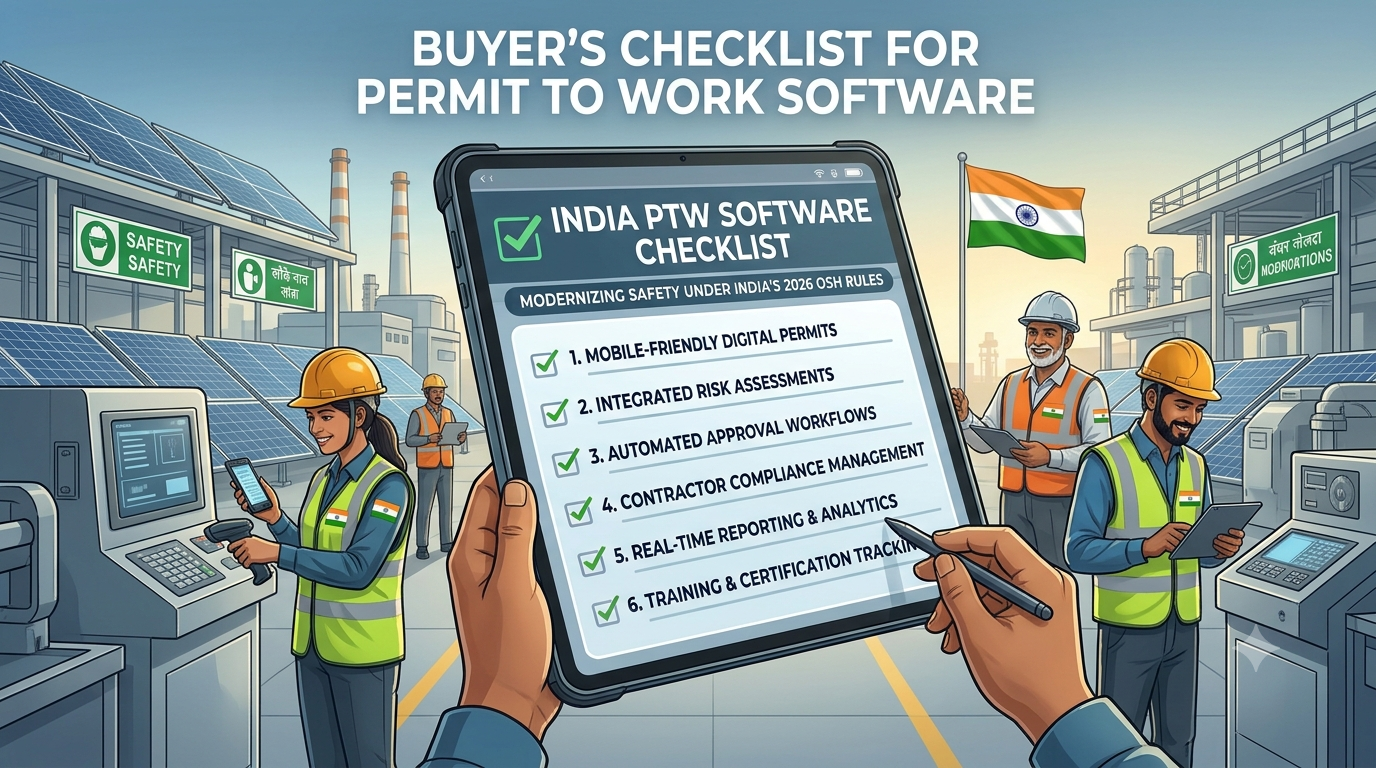
What to Evaluate When Selecting Permit to Work Software India
No two projects are identical. The following criteria help project heads and safety officers assess platforms without relying on vendor claims alone.
1. Regulatory Alignment
Confirm that permit form templates can be configured for IS 17893:2023 categories — cold work, hot work, height work, confined space, electrical work, and radiography. The platform should also support the documentation requirements under the OSH Code 2020 and ISO 45001 Clause 8.
2. Role-Based Access and Approval Workflows
A PTW process involves multiple actors — the permit issuer, the performing authority, the area authority, and safety officers. A permit should be issued only by a competent person who is completely familiar with the work and the work area. Your platform needs configurable role logic that enforces this chain without manual workarounds.
3. Mandatory Pre-Checks and Simultaneous-Operations Management
Permit forms can be configured for different work categories such as hot work, confined space entry, or excavation. Each permit can include mandatory safety checks so that key precautions are verified before approval. For complex sites, simultaneous operations — multiple high-risk activities occurring concurrently in the same or adjacent areas — are responsible for a disproportionate share of serious incidents on complex construction and industrial sites. Digital conflict-detection is not a luxury on such sites.
4. Audit Trail and Report Generation
Every permit action — submission, conflict check, approval, gas test entry, and closure — should be timestamped and stored in one retrievable record, so a full permit history can be pulled in seconds instead of the days it can take to locate the right paper form and matching sign-off sheets after an incident. Look for branded PDF export capability and MIS-level dashboards for corporate reporting.
5. Mobile and Offline Capability
Indian construction sites — particularly infrastructure projects in semi-urban corridors — frequently operate with patchy connectivity. A progressive web app (PWA) architecture, or native offline mode, is worth verifying before contract signing.
6. Integration with EHS Audit and CAPA Modules
A permit to work record is most useful when it connects to the broader EHS audit framework. Corrective actions triggered by a permit non-conformance should flow directly into the same system that tracks audit findings, rather than being logged separately.
7. Gulf Region Acceptance
For contractors operating across both India and the Gulf, confirm that the platform's audit trail and approval workflow meet the equivalence requirements of GCC regulators. GCC regulators such as OSHAD, Dubai Municipality, Saudi Aramco, and ADNOC accept digital PTW systems when they include controls equivalent to paper systems — typically an audit trail, approval workflow, and record retention capability.
How SafeOps360 Fits into This Picture
SafeOps360 by VizionForge is an enterprise QHSE and safety intelligence platform designed for construction and infrastructure projects. It is not a standalone permit to work tool, but its architecture is relevant to teams evaluating the broader digital safety stack that PTW software sits within.
The platform supports EHS Audit workflows structured around ISO 45001 compliance — the same standard that explicitly requires a permit to work system on hazardous sites. Its five user roles (Admin, Project Head, Auditor, Auditee, and Viewer) map directly to the kind of multi-party approval chains a PTW process demands, and its granular access control prevents unauthorised users from progressing or closing permits out of sequence.
SafeOps360 generates branded PDF reports, tracks corrective actions, and offers an MIS dashboard for corporate-level visibility — capabilities that address the audit trail and reporting expectations that IS 17893:2023 and ISO 45001 both require. The platform is deployed on Azure and built on React PWA and OutSystems ODC, which means it can function on site with variable connectivity. It is used by Tata Realty, with reported usage across 25+ projects and 397+ audits managed.
Teams assessing permit to work software India should verify which specific PTW categories SafeOps360 supports and confirm fit against their site-specific workflows directly with the vendor.
Frequently Asked Questions
Is permit to work software legally required in India?
The OSH Code 2020 consolidates 13 Central Labour laws into a single comprehensive legislation applying across industries and states. While the Code does not prescribe a specific digital format, it requires employers to control hazardous work activities — and a formal PTW process, whether paper or digital, is the standard mechanism used to demonstrate that control. IS 17893:2023 provides the code of practice against which that process is measured.
What types of permits does IS 17893:2023 cover?
The standard provides guidance for work areas whose activities are restrictive in nature, including cold work, hot work, and radiography. It also covers electrical work and height work. Confined space entry is covered under the broader hazard categories requiring risk assessment and precautionary verification before work commences.
How long does it take to transition from paper to digital PTW?
Transition from paper to digital PTW requires careful planning — running parallel systems for four to six weeks during transition reduces the risk of permit gaps and builds user confidence before paper systems are removed. Timeline varies depending on the number of permit categories, the size of the site workforce, and how much workflow configuration is required before go-live.
Can digital permit to work software be used for Gulf projects as well?
Yes. GCC regulators including OSHAD, Dubai Municipality, Saudi Aramco, and ADNOC accept digital PTW systems when they include equivalent controls to paper systems — typically an audit trail, approval workflow, and record retention capability. Indian contractors working across both markets should confirm that the platform they select meets these documentation standards in both jurisdictions.
What is the difference between a PTW system and an EHS audit platform?
A PTW system controls access to hazardous work in real time — authorising, monitoring, and closing specific tasks. An EHS audit platform records compliance status against defined standards across a project. The two overlap when permit non-conformances generate corrective actions that feed into the audit record. Platforms that unify both functions reduce the administrative load on site safety teams and create a single evidence base for regulatory inspections.
Sources
- Construction in India: a dangerous business | British Safety Council India
- A study to determine human-related errors at the level of top management, safety supervisors & workers during the implementation of safety practices in the construction industry - ScienceDirect
- Work Permit System – Code of Practice: IS 17893: 2023
- Occupational Safety, Health and Working Conditions Code, 2020 in India | Safety, Health & Working Conditions - LLR
- Occupational Safety, Health and Working Conditions (OSH) Code, 2020
- ISO 45001:2018 - Occupational health and safety management systems
- Digital Permit to Work System vs Manual PTW: Which Is Better? - ehs4safety
- Safety Work Permit System Ensures Safe Workplace Operations
- Digital Permit to Work vs Paper: Complete Comparison 2026 | SmartQHSE | SmartQHSE
- Digital Permit-to-Work: Hot Work & Confined Space System
- Full text of "IS 17893 : 2023: Work Permit System-Code of Practice"