On 30 June 2025, a dryer explosion at the Sigachi Industries plant in Pashamylaram, Telangana, killed more than 40 workers. The state set up an expert committee to investigate. Its findings, not commentary, are the record of what happened.
The reason to start there is the question every investigation eventually asks: what did the site already know? For most industrial and construction sites, the honest answer is "less than it should have", because close calls are the events least likely to be written down.
What changed in the law
The Occupational Safety, Health and Working Conditions Code came into force on 21 November 2025, consolidating 13 earlier central laws. The OSH (Central) Rules, notified on 8 May 2026, set the working procedures, including notice of accidents and dangerous occurrences. States are notifying their own rules (Rajasthan, Bihar and Andhra Pradesh among them).
A dangerous occurrence is the legal cousin of a near miss, not the same thing. But the direction is plain: reporting is moving from "if someone was hurt" towards "if something could have hurt someone". Check the rules that apply in your state, and keep your timelines and forms in one system rather than three.
What ISO 45001 already expects
If you hold or are working towards ISO 45001, clause 10.2 requires you to investigate incidents and nonconformities and take corrective action. Clause 9.1 requires monitoring and measurement of OH&S performance. Near-miss frequency is a leading indicator for that. Auditors ask for the chain: report, investigation, corrective action, closure.
What the software must do
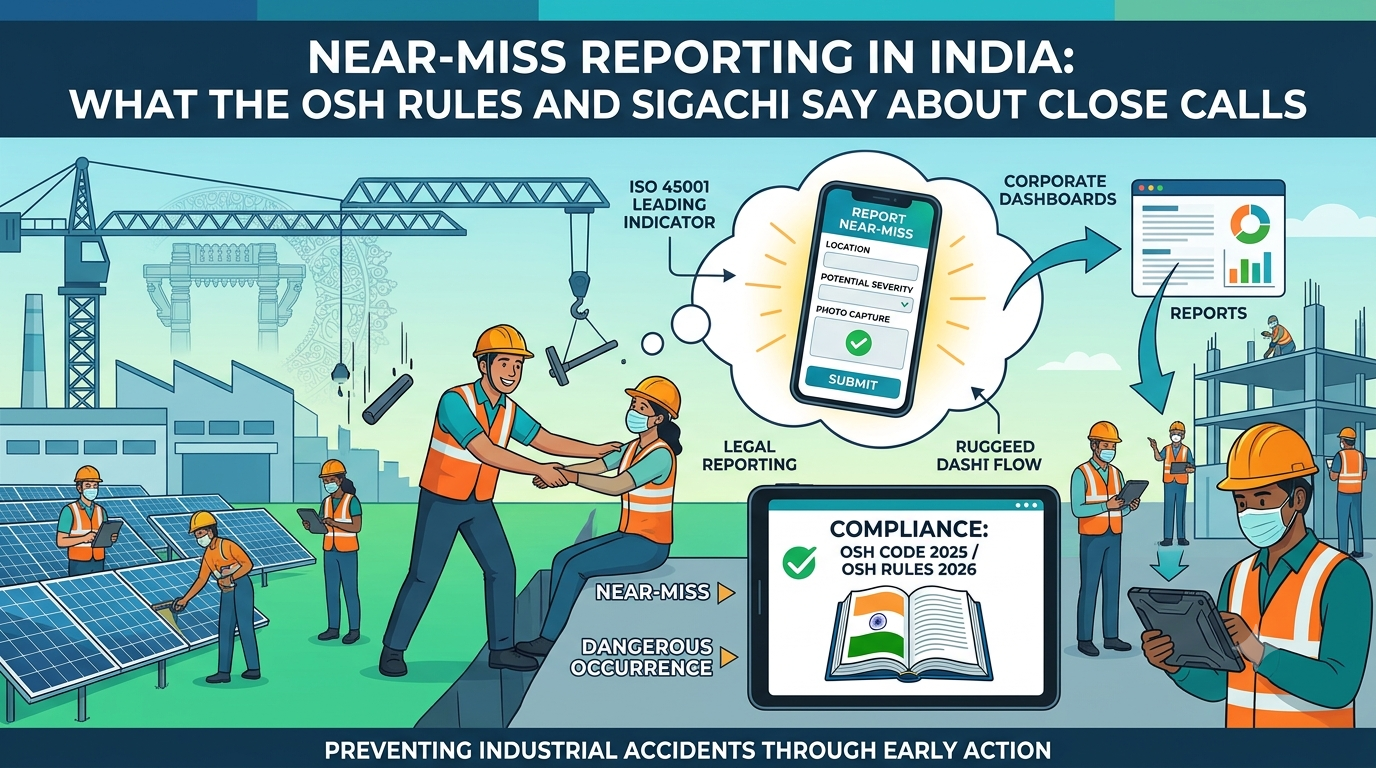
1. Capture on the phone, at the spot. If a report takes more than a couple of minutes, it will not be filed. Photos at capture.
2. Structured fields, not free text. Location, time, potential severity, immediate action.
3. A real investigation step. Root cause, owner, due date.
4. Corrective action with ownership and escalation. Overdue actions should be visible without anyone chasing.
5. Cross-site views for management. Leading indicators (near misses reported, action closure rate) beside lagging ones (TRIR, LTIFR).
6. Role-based access. A contractor's supervisor should not see the corporate view.
7. Audit-ready output. A formatted record a regulator or client auditor can read.
The part software cannot fix
Closing the action is not the same as changing the design. If the same near miss keeps coming back with a new corrective action each time, the loop is closing on paper and nothing upstream has changed. Software can make that pattern visible. Someone still has to act on it.
Reporting also depends on people trusting that a report will not be used against them. Treat it as a culture problem first and a tooling problem second.
Where SafeOps360 fits
SafeOps360 is VizionForge's QHSE platform for construction and infrastructure projects. It tracks corrective actions from EHS audits through to closure, with five roles (Admin, Project Head, Auditor, Auditee, Viewer), an ISO 45001-aligned EHS audit module, branded PDF reports and an MIS dashboard across projects. If incident and near-miss capture is your main requirement, ask us for a walkthrough of exactly what is live today. Contact us.