
Managing business expenses efficiently is essential for every organization. From employee travel and accommodation to client meetings, office purchases, and daily reimbursements, companies handle hundreds or thousands of expense transactions every month. Traditional expense management processes often involve manual data entry, lengthy approval cycles, misplaced receipts, and avoidable errors that consume valuable time for finance teams.
This is where AI expense management software is transforming the way businesses manage their finances. By combining artificial intelligence, automated receipt scanning, intelligent expense categorization, and policy validation, modern expense management solutions help organizations simplify expense reporting and improve financial visibility.
Instead of manually entering every transaction, employees can capture receipts and allow AI to extract relevant information, categorize expenses, and prepare claims for approval. Finance teams can spend less time correcting errors and more time focusing on budgeting, reporting, and strategic financial planning.
For enterprises looking to modernize their finance operations, AI-powered expense management offers a practical approach to improving productivity, accuracy, and control. Solutions such as VizionForge ExpenseGenie bring AI-driven expense automation and SAP integration together to streamline the expense management process.
What Is AI Expense Management Software?
AI expense management software is a digital solution that uses artificial intelligence and machine learning to automate and improve the way businesses record, process, validate, approve, and report employee expenses.
Traditional expense management systems frequently depend on employees entering transaction details manually. Finance teams must then review receipts, verify expense categories, check company policies, and ensure that the information is correctly recorded in accounting systems.
AI expense management software reduces this manual workload by automating several stages of the process.
Key capabilities include:
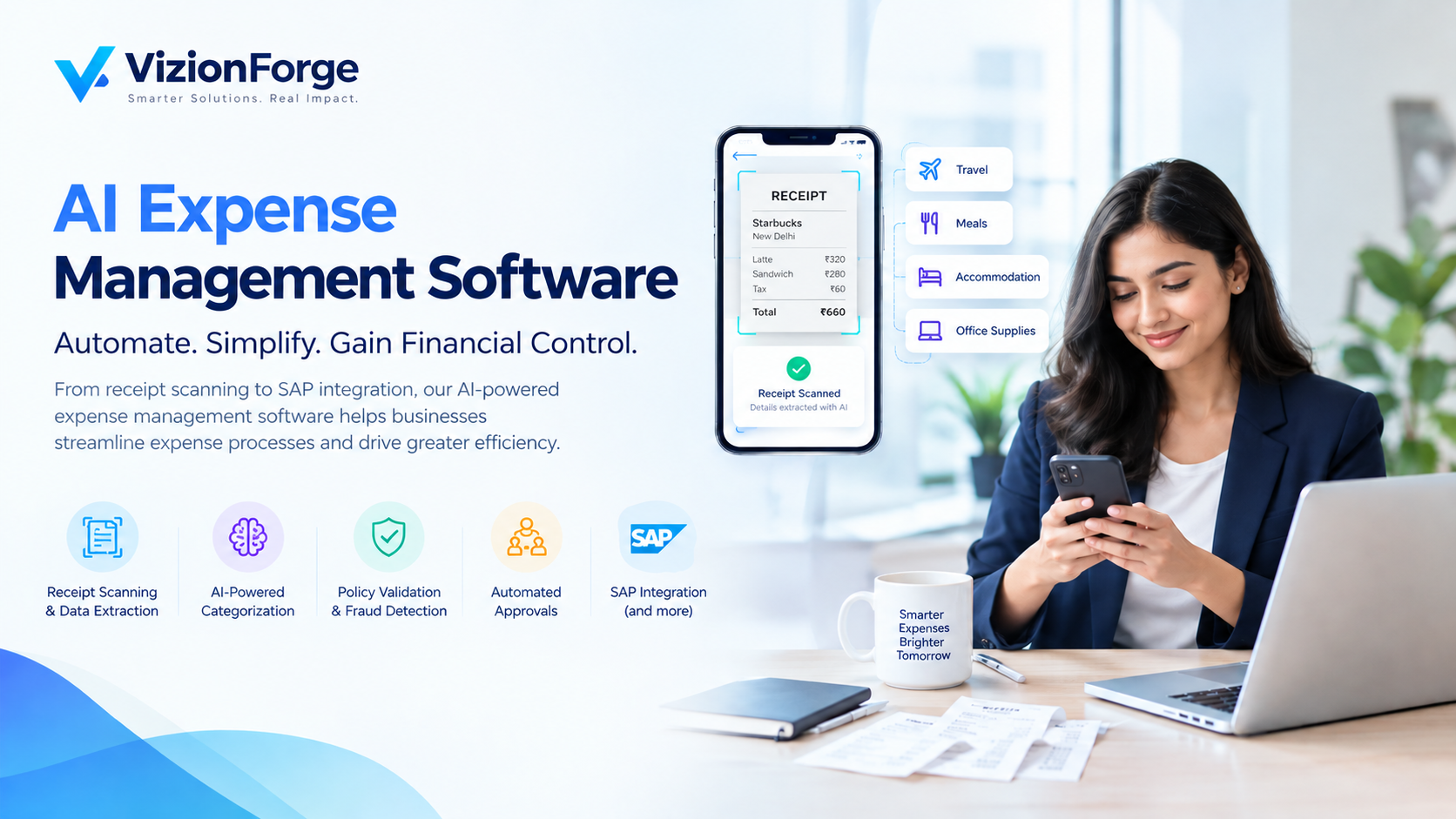
Automated receipt scanning: Extracts vendor names, transaction dates, invoice amounts, and tax details from receipt images.
Intelligent expense categorization: Classifies transactions into categories such as travel, meals, accommodation, and office supplies.
Expense policy validation: Checks submitted claims against configured company rules and spending limits.
Duplicate expense detection: Identifies potentially repeated receipts or suspicious duplicate claims.
Automated expense reporting: Organizes transaction details into structured expense reports.
Accounting system integration: Transfers approved expense information into connected financial platforms, including SAP where supported.
By bringing these capabilities together, AI expense management software helps organizations build a more efficient, transparent, and scalable expense management process.
Why Businesses Need AI-Powered Expense Management
As organizations expand, expense management becomes increasingly complex. Companies may have employees working across different locations, departments, currencies, and business units. Managing every expense manually creates additional administrative work and increases the possibility of errors.
AI-powered expense management addresses these challenges by reducing repetitive tasks and creating a more consistent workflow.
1. Reduce Manual Data Entry
Manual expense reporting requires employees to enter information from receipts, select expense categories, upload supporting documents, and complete claim forms. This process can be time-consuming, especially for frequent business travelers.
AI expense management software uses document intelligence and optical character recognition (OCR) to extract information directly from receipt images. Employees can review the extracted details instead of typing every field manually.
This approach simplifies expense submission and helps employees spend more time on their primary responsibilities.
2. Improve Expense Processing Accuracy
Incorrect amounts, missing dates, wrong expense categories, and duplicate claims can create problems during financial reconciliation.
AI expense management software can automatically validate extracted information, identify inconsistencies, and flag transactions that require additional review.
Although AI can significantly reduce manual errors, human verification may still be necessary for unclear receipts, unusual transactions, and exceptions to company policies.
3. Accelerate Expense Approvals
Traditional expense approval workflows often involve emails, spreadsheets, and repeated follow-ups between employees, managers, and finance departments.
With automated expense management, claims can be routed to the appropriate approvers according to predefined business rules. Policy checks and validation can happen before submission, helping reduce avoidable rejections and delays.
Faster processing also supports a smoother reimbursement experience for employees.
4. Strengthen Financial Visibility
Finance teams need accurate, timely information to understand where business money is being spent.
AI expense management software can organize expense data into useful categories and support reporting on departmental spending, travel costs, employee reimbursements, and budget utilization.
When connected to business intelligence tools, this information can help decision-makers identify spending patterns and make more informed financial decisions.
Key Features of Modern AI Expense Management Software
When evaluating an AI expense management solution, businesses should look beyond basic digital forms. The right platform should support the complete expense workflow while fitting into the organization's existing technology environment.
Intelligent Receipt Scanning and Data Extraction
Receipt scanning expense automation is one of the most valuable applications of AI in financial operations.
Employees can photograph a receipt or upload a digital document. The system extracts relevant information, such as:
Merchant or vendor name
Transaction date
Total amount
Invoice or receipt number
Tax information, including GST where applicable
Suggested expense category
Advanced document intelligence can also process certain low-quality or faded receipts. However, extraction quality depends on the document, language, image quality, and system configuration.
Automating this step reduces repetitive data entry and creates structured information for downstream processing.
Automated Expense Categorization
Every business follows specific accounting categories and expense policies. Manually classifying each transaction can slow down reporting and introduce inconsistencies.
AI expense management software can suggest appropriate categories by analyzing receipt information and transaction context. For example, a hotel invoice may be categorized as accommodation, while a restaurant receipt may be identified as a meal expense.
Organizations can configure categories and validation rules according to their internal accounting requirements.
Intelligent Policy Compliance
Expense policies establish the rules employees must follow when spending company money. These policies may cover meal limits, travel allowances, accommodation costs, approval thresholds, and documentation requirements.
AI-powered systems can compare submitted expenses against configured rules and flag potential violations.
This gives finance teams a more consistent way to review claims while helping employees identify issues before submitting them.
Duplicate Detection and Expense Validation
Duplicate reimbursements can increase costs and complicate financial audits.
AI expense management software can use receipt details, transaction amounts, dates, and other available information to identify potentially duplicated claims.
Validation rules can also highlight missing information, unusual amounts, and transactions that require further investigation. These alerts support better controls without assuming that every flagged transaction represents fraud.
Integration With ERP and Accounting Systems
Expense management should not operate as an isolated process. Businesses need expense data to flow accurately into their accounting and enterprise resource planning systems.
SAP integrated expense management software helps connect expense submission and approval workflows with financial processes in supported SAP environments.
With appropriate integration, organizations can reduce duplicate data entry, improve consistency between systems, and simplify reconciliation.
How AI Expense Management Software Works
A well-designed AI expense management workflow can simplify the employee experience while maintaining financial controls.
Step 1: Capture the receipt
An employee photographs a receipt, uploads a document, or provides transaction details through an available interface.
Step 2: Extract expense information
AI-powered document processing identifies relevant fields, including vendor, date, amount, and applicable tax details.
Step 3: Categorize the expense
The system suggests an appropriate expense category based on extracted information and configured business rules.
Step 4: Validate the claim
The software checks for missing details, duplicate claims, policy exceptions, and other issues requiring attention.
Step 5: Submit for approval
The completed expense claim moves through the configured approval workflow.
Step 6: Integrate with financial systems
Once approved, the expense information can be transferred to the connected accounting or ERP platform, depending on the integration setup.
This workflow helps organizations reduce repetitive administrative tasks while maintaining appropriate approval and verification controls.
Benefits of AI Expense Management Software for Enterprises
Implementing AI expense management software can deliver benefits across finance, HR, operations, and employee experience.
Increased Operational Productivity
Automating receipt extraction, categorization, and validation reduces the number of repetitive tasks performed manually. Finance professionals can dedicate more time to analysis, forecasting, and financial planning.
Lower Administrative Costs
Reducing manual data entry and unnecessary corrections can help businesses manage growing transaction volumes without increasing administrative effort at the same rate.
Better Compliance and Audit Readiness
Structured expense records, approval histories, and validation checks make it easier to review transactions and maintain supporting documentation.
Improved Employee Experience
A straightforward expense submission process reduces the frustration associated with complicated forms and repeated claim corrections.
Scalable Financial Operations
As organizations expand into new markets or increase their workforce, automated expense management can support higher transaction volumes through standardized workflows and configurable rules.
The actual benefits depend on implementation quality, existing processes, transaction volumes, and employee adoption.
Why SAP Integrated Expense Management Software Matters
For enterprises using SAP, connecting expense management with their existing financial environment is particularly important.
SAP integrated expense management software helps reduce the gap between employee expense reporting and accounting operations. Instead of relying on separate spreadsheets and manual data transfers, organizations can establish a more connected process for approved expenses.
A suitable integration can support consistent financial records, reduce duplicate entry, and improve the availability of expense information for reporting and reconciliation.
Before implementation, businesses should evaluate their SAP environment, integration requirements, approval workflows, security controls, and data governance needs.
The objective is not simply to digitize expense forms. It is to create a connected process that supports employees, finance teams, and enterprise financial systems.
Introducing ExpenseGenie by VizionForge
ExpenseGenie by VizionForge is an AI-powered expense management solution designed to simplify expense submission, validation, and processing for enterprises.
Built using Microsoft Azure technologies, ExpenseGenie combines conversational AI, document intelligence, and SAP integration capabilities to help organizations modernize expense management.
Its key capabilities include:
AI-powered receipt processing: Extracts expense information from uploaded receipt images.
Conversational expense submission: Allows employees to interact using natural language rather than navigating lengthy forms.
Automated validation: Supports policy checks, duplicate detection, and budget-related validation.
SAP integration: Supports posting approved expense information to SAP S/4HANA through the configured integration.
Streamlined workflows: Helps reduce repetitive work across expense submission and approval processes.
VizionForge presents ExpenseGenie with a target implementation timeline of four weeks, alongside published performance claims of 90% faster processing, 75% fewer errors, and three times faster reimbursement. Organizations should validate these figures against their own requirements, baseline performance, and implementation scope.
For companies seeking AI expense management software that aligns with enterprise systems, ExpenseGenie offers an approach focused on reducing manual effort and improving the expense management experience.
How to Choose the Right AI Expense Management Software
Selecting the right platform requires more than comparing feature lists. Businesses should consider their current financial processes and long-term technology requirements.
Evaluate the following factors before making a decision:
Automation capabilities: Check whether the solution supports receipt extraction, categorization, validation, and approval workflows.
ERP integration: Confirm compatibility with your SAP or other accounting environment.
Security and access controls: Review data protection, user permissions, audit trails, and organizational security requirements.
Customization: Ensure expense categories, policies, approval hierarchies, and reporting requirements can be configured appropriately.
Employee usability: Look for an intuitive experience that reduces training requirements and encourages adoption.
Implementation and support: Understand deployment timelines, integration dependencies, testing requirements, and ongoing support.
Measurable ROI: Establish baseline processing times, error rates, administrative costs, and reimbursement timelines before evaluating results.
A structured evaluation helps businesses choose AI expense management software that delivers practical value rather than adding another disconnected application.
The Future of AI Expense Management
Artificial intelligence is changing enterprise finance by making routine processes more automated, connected, and data-driven.
Future expense management systems are likely to place greater emphasis on intelligent workflow orchestration, contextual validation, predictive spending insights, and AI agents that can coordinate multiple steps within defined business rules.
These developments can help finance teams identify potential issues earlier, improve policy adherence, and reduce the time spent on routine administrative activities.
However, successful adoption will continue to depend on reliable data, clear governance, secure integrations, and appropriate human oversight.
Businesses that approach automation strategically can build more responsive financial operations while maintaining the accountability required for enterprise expense management.
Conclusion
AI expense management software is becoming an important part of modern enterprise finance. By automating receipt scanning, expense categorization, policy validation, approvals, and financial system integration, organizations can reduce manual work and improve visibility into business spending.
For enterprises using SAP, integrated expense automation can further simplify financial workflows and reduce repetitive data entry between systems.
VizionForge helps organizations explore this approach through ExpenseGenie, combining conversational AI, document intelligence, and SAP-connected expense processing in one solution.
If your business is looking to simplify reimbursements, improve expense reporting, and modernize finance operations, explore VizionForge ExpenseGenie to learn how AI-powered expense management can support your organization's goals.